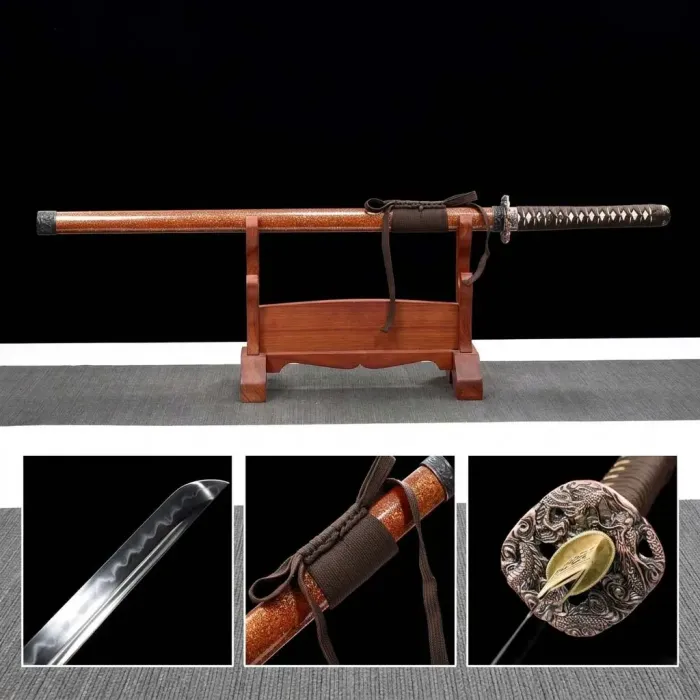
The conventional Japanese sword acts as a exquisite display of technique, but suppose you aim to to communicate your personal manner? Adapting your gear is a significant journey, allowing you to forge a truly uncommon piece. From the hilt wrapping and sheath to the shield design and temper line, each detail offers a chance for distinctive style. This exploration delves into the sphere of katana modifications, providing knowledge for both beginners and expert enthusiasts seeking to imprint their stamp on the time-honored art of the samurai.
Introductory Real Mastery
For people ready to embark on the rewarding journey of martial arts involving swords , 1060 steel katanas furnish an excellent entry point. This distinct grade of essential steel strikes a golden mean between expense and proficiency. While lacking compared to hard as leading steels, 1060 supports a reasonable level of cutting preparation , making it appropriate for newcomers to acquire the groundwork of sharpening care and appreciate the elegance of handcrafted Japanese weaponry. It’s a excellent choice for establishing experience without the fiscal burden of more elite steels.
Grade T10 Cutlasses: Balancing Performance and Price
To help hobbyists seeking an authentic blade experience without shattering the wallet , T10 metal katanas represent a attractive option. These blades offer a reasonable improvement in toughness compared to cheaper alternatives, exhibiting good edge retention and sufficient flexibility for basic cutting techniques. While not rivaling the exquisite characteristics of ultimate steels like T100 or folded substance , T10 provides a commendable blend of efficiency and reasonableness , making them a trendy choice for novices and those on a tight salary .
Exceeding the Keel : Adapting Your Blade's Adornments and Grip
While the smoothed cutting surface is undeniably the main point of a katana, truly refining its magnificence lies in the precise customization of its components and grip . This operation allows admirers to demonstrate their unique design . Reflect on the vast possibilities: menuki - decorative trinkets that provide visual allure ; the hamon casings – often finely fashioned ; the tsuka body itself, wrapped in traditional ito cord ; and the fusa pommel , which can be fabricated from various elements like treasures or ivory .
- Prefer designs that resonate with you.
- Assess with varying resources .
- Emphasize strength for a enduring mark .
The Love of the Katana: Antiquity, Formation, and Composition
This oriental cutlery bears a incomparable allure, steeped in epochs of Asian history and tradition . More than merely a instrument of hostilities , it's a representation of the knight ethos – a fusion of prowess and restraint . Its maturation spanned score generations, with early steel evolving into the polished curvature and effective edge we acknowledge today. The fabrication involved is truly impressive , requiring years of study to excel at . The process involves a sophisticated folding of tamahagane , creating layers that strengthen the edge’s flexibility and cutting ability. Multiple schools of crafting appeared , each with their separate secrets and techniques for achieving the perfect stability and precision - a truly exacting pursuit.
- Former Katana designs
- The role of the nihonto in bushi culture
- Classic crafting styles
Opting for the Suitable Steel for Your Armament Project: 1060 vs. T10
Determining the favorable steel is essentially important for any cutlery project, and the conclusion between 1060 and T10 can be intricate. 1060 is a frequented American element, offering a competent balance of rigidity and persistence, supplying it comparatively easy to manage. However, T10, a Far Eastern steel, ordinarily boasts heightened wear sustainability and can likely achieve a increased conclusive hardness, although it can be markedly troublesome to handle and requires precise heat conditioning. Consider your expertise and intended effects: for a first-timer, 1060 may be a easier starting point, while the expert smith might admire the augmented attributes of T10.
- Convenience of Working
- Longevity
- Decisive Rigidity
Discovering Power: Refined Katana Adaptation Practices
Mastering the art of katana alteration extends far beyond basic finishing. Serious practitioners are now analyzing advanced techniques to truly activate a blade's hidden potential. This entails intricate work with the hamon, utilizing specialized products for differential heat treating and carefully nominating the contour of the guard to optimize balance and operation. Beyond purely functional refinements, artisans are increasingly focused on achieving unparalleled aesthetic elegance, through complex carving and layered varnishes that truly transform a katana into a showpiece.
Shaping Rough Steel into Perfection: Making a 1060 Sword
The journey starts with average 1060 metal , a strong material far away the fine katana it will evolve . Accomplished bladesmiths utilize a sophisticated process of layering and forming the raw steel, repeatedly burning it and flattening it to discard impurities and build a swords katana even grain structure. This tiring process, often lasting for periods , builds the important toughness and malleability characteristic of a true Japanese weapon . Supplementary heat treatments , including exact hardening and curing , are critical to achieve the specific proportion of sharpness, durability and grace .- Combining: Diminishes impurities and creates grain structure.
- Crafting: Molds the steel into the initial blade form.
- Cooling: Determines the final hardness and flexibility.
The Durable Charm of the Katana: Intensive Inspection of Steel and Adaptation
An historic katana holds present a intense symbol of Japanese heritage , its charm far outshining mere artillery . Forged from select steel and usually featuring intricate designs , the method of creation itself is a respected art. Beyond the core craftsmanship, the ability to tailor a katana - from the quench mark to the shaft wrapping and fitting - provides for a honestly individual exhibition for both curators and practitioners alike. This combination of historical steelwork and boundless personalization contributes the katana's continued popularity across the globe .
